skip to main |
skip to sidebar
 A Sikh warrior on guard at the Golden Temple in Amritsar.
While Hinduism accounts for about 80% of India's population, and Islam another 13%, other native religions include Buddhism, Jainism and Sikhism.
About 75% of the world's Sikhs live in the state of Punjab, where they make up about 60% of the population. Over the last century, Sikh migration has led to the development of a number of significant Sikh communities throughout the rest of the world, and especially areas of Ontario and British Columbia in Canada.
For more information about Sikhism, check out A Brief Sikh History or sikhnet.com.
Like any developing country, India's drinking water is NOT safe to drink straight from the tap. Finding clean water is no problem though. Bottled water is virtually everywhere in India. People in India may also refer to this as mineral water. Whether you are in rural India or within the city, you will find bottled water in places such as resturants, street vendors, and shopping centers.
How Much Does It Cost?
A 1 litre bottle of water cost about 50 cents US. Typically an average person will go through minimum 2 litres of water each day. Expect to pay $30-$50US/month for each person. Depending on how long you plan on staying in India, it may be worth it to buy a water purifier. These range from around $100US to $200US. This can save a lot of money in the long run. If you have a group of six people traveling for one month, bottled water will cost roughly $180-$300US.
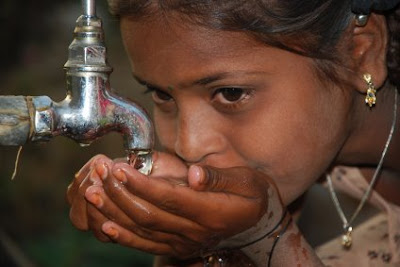
Safety Precussions
There are a few things you can do to limit your chances of getting sick:
- Check Your Bottles! Always make sure the seal of your bottle has not been opened. After you are finished with your water bottle, always crumple it up before trashing it. If the bottle looks reusable, IT IS. Some places will find used bottles and refill them with unclean water which are then used for resale. So please, ALWAYS make sure your bottle is sealed.
- Brush! Brushing your teeth can make you sick if you are not careful. It is recommended that you wash your toothbrush with either boiled or mineral water.
- Shower! This can be hard to do. In most budget hostels, hotels, and guest houses, the shower water has not been purified. You must be careful showering! One drop of water may be just enough to keep you up all night.

Hiring a Rickshaw
Hiring a rickshaw for a decent value can take practice and composure. Most rickshaws contain a small meter box that will measure your route in both kilometres and rupees. This is utterly useless. Ninety-nine percent of the time rickshaw drivers will lie, claiming the meter box is broken. This is obviously because they want to charge more than the actual price. Just remember: never offer more than half of the asking price and always negotiate a price before you leave. If you have not negotiated an appropriate price, the rickshaw driver has every right to charge more then he should at the destination.
Here’s a story. . .
“I was hiring a rickshaw driver outside of Vasant Kunj, Delhi and was heading towards New Friends Colony, Delhi. The rickshaw driver had requested a price of 150/-RS (about $4 US). I had taken this route several times and knew that a fair and reasonable price was 70/-RS. The driver was honest and had told me that because I am a foreigner and have more money than he could ever dream of, it was my responsibility and obligation to pay a higher fare. In the end, I ended up paying my 70/-RS.” Just remember – Be Firm!
Hiring a Taxi
When hiring a taxi, usually the best deals are found through the places you are staying such as your hotel, hostel, or guest house. By booking a taxi through your residence, you save the hassle of bartering as well the language barrier. You will be given the option of either hiring a taxi for one way which will cost anywhere from 200/-RS. to 300/-RS. ($5 - $8US) or hire a car and driver for the day. For this particular option, you could expect to pay about $50/day with the car and driver. This option is great because it saves so much hassle.
Mosquito nets help avoid the risk of infections such as Malaria. While traveling in India it is important to know in which regions you will be at risk. Generally mosquito nets are needed in states below 2000m, and especially in rural areas.
Beyond the risk of infection, India also inhabits an exceptionally large number of insects...
 Above: Mosquito, Below: Dung Beetle
 On a personal note, I find comfort very important when I sleep. I had an experience on a camel trek through Rajasthan in 2008 that I won't soon forget. To assist our group of four, we hired two porters, whose job is to pack and carry the group's necessary gear. This was to included the basics; a quilt, pillows, blankets, food, and a tent (or so we thought). Having not clarified this prior to entering the desert, our porters did not have a tent. This is when I completely regretted not bringing my mosquito net. The Rajasthani desert is apparently renowned for its DUNG BEETLES! Let me say, I had the worst sleep of my life that night.
Good places to find mosquito nets will include local camping and outdoors supply stores, travel clinics, or you can also find a wide variety of mosquito nets online from stores like the Great Outdoors Depot and Mountain Equipment Co-op.
When traveling in India, it is important to note that the electric current is 240 volts alternating at 50 Hertz (cycles per second). If you wish to travel with incompatible electric equipment, you will require a voltage converter. The following three converters will do the job:
- Resistor-Network Converter
Pros; lightweight, will support high-wattage devices like irons and blow dryers of approx. 50-1600 Watts
Cons; should not be used for extended periods of time, not recommended for digital devices
- Transformers
Pros; recommended for low-wattage electronics such as battery chargers, cameras, laptops, mp3 players etc.
Cons; heavier weight, only supports low-wattage devices of approx. 50-100 Watts
- Combination Converters
These are a combination of a Resistor-Network and a Transformer in one product. Combination converters are easy to switch between the two modes, and are highly recommended for anyone who plans to spend a lot of time traveling in foreign countries.
 It is also important to know that India's standard electric socket configuration is the old British plug, "Type D". As shown in the illustration above, the Type D plug uses three pins configured in a triangle.
Technically, the act of bartering means to negotiate a price for goods or services in the form of a trade. In India, however, you will find this term most often referring to negotiating a lower price, also referred to as 'haggling' or 'bargaining'.
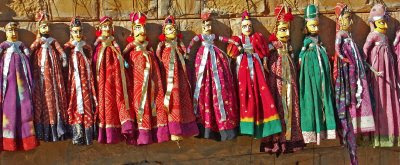 Photo: Traditional marionettes for sale in Jaisalmer, Rajasthan, India.Bartering in India is very much a part of the culture. While some shops will have a strict 'No Bartering' policy, many store merchants will purposely overprice goods and services in anticipation of their customers bartering for a lower price.
Generally speaking, a good place to start in your average shop is to offer about half the asking price. Usually a settlement can be made for about three quarters or less than the original price.
Street vendors will often be more ruthless, especially with foreigners. From my own experience, the best way to get the best deal is is to express interest in an item, but not offer a price. Instead, decline whatever the merchant has quoted, and walk away, saying that is too much. Walking away is the key - the price will immediately drop, often to about half. Remember that while it often seems like they're trying to rip you off, it’s most often that they are just trying to provide for their families, and see foreigners as having too much money to begin with.


 Posts
Posts

